
Reflections on the SC19 meeting
in Berlin
by Joseph V. Masin, delegate to WG3, on behalf of Trovan, Ltd.

It became very apparent that a number of nations will be submitting requests for major revisions of ISO 11784/85 in the near future. It is apparent that the standard in its present form is not acceptable to a large portion of the livestock producing nations. A significant number of WG3 members, including manufacturers, have in private conversations with myself admitted the deficiencies and major flaws of the standard, which largely coincide with the points made in the document entitled "A discussion of the ISO standard for RFID: its provenance, feasibility and limitations." They have however requested not to be quoted by name.
(1) The standard cannot ensure unique ID codes
(2) The standard is needlessly complex, combining two incompatible technologies: FDX and
HDX.
(3) Legal issues continue to impact the standard
(4) Livestock and small animal identification have different requirements and require
separate standards.
(1) The standard cannot ensure unique ID codes
ISO 11785 claims that ID codes of conforming transponders will be unique. In section 2,
entitled "conformance," the standard states: "The unique individual
identification codes transmitted by a transponder are in conformance with this
International Standard provided they meet the requirements of clause 5." (emphasis
added). The assumption of uniqueness is dangerous.
The idea has been put forward that manufacturers will police their own transponders. However, this would assume that every manufacturer will bother to apply for a manufacturers' code and that every manufacturer will program his transponders with only his manufacturers' code and nobody else's. Today, there is a great deal of confusion as to how the term "manufacturer" should even be defined (and consequently how "manufacturer responsibility for code uniqueness" should be assigned). Is it the manufacturer of the integrated circuit? Or is it the no-name manufacturer of transponder assemblies? Or is it the private label reseller of the transponder who is putting the transponder in the market under his brand name? Who bears the responsibility for ensuring manufacturer codes are used only by the designated manufacturer? (particularly in an environment where noone can be restrained from programming any code they want, or even reprogramming it, if they so choose). Companies may not restrict traffic in their goods between different geographical areas. (This principle has recently been reaffirmed by EEC court rulings and also impacts trade in transponders with pre-designated country codes).
Initially when the standard was first conceptualised in 1991, OTP (one-time-programmable) and WMRM (reprogrammable) transponders were not available. The standard is written in such a way that it makes no allowance for the introduction of these technologies. The standard actively misleads consumers into believing that the transponders provided under its aegis will be unique.
In fact, as stated by organisations that are operating registration databases, inclusion of ISO-standard compliant transponders in databases will make such databases unusable. The logical progression would be that, after an installed base of ISO-compatible readers were put into place, ISO-compatible transponders will be marketed as unprogrammed "blank" chips, with the number to be programmed once the transponder is implemented. The veterinarian or even the owner of the animal could add pertinent information such as the owner's telephone number. This approach, although a natural outgrowth of today's technological reality, would essentially make databases obsolete.
(2) The standard is needlessly complex, combining two incompatible technologies: FDX
and HDX.
It is a fact that no commercially available reader today reads both FDX and HDX
ISO-compliant transponders. Such a reader would be more complex to manufacture,
inordinately costly to users and would compromise the performance of both the FDX and HDX
systems, resulting in slower read speeds and potentially shorter read ranges.
To date, twelve companies (self-designated manufacturers) have announced their intent to sell ISO compliant transponders. Only one of these companies is manufacturing HDX transponders, which would be suitable for livestock ID. A tally of manufacturers clearly shows that the preferred technology, by an overwhelming margin, is FDX, for technical and operational reasons. There is no possibility, with the current state of the technology, to produce these HDX transponders in miniaturised form due to the need for a larger number of components. It is axiomatic in electronics that a larger number of components and connections results in a greater likelihood of system failure.
(3) Legal issues continue to impact the standard
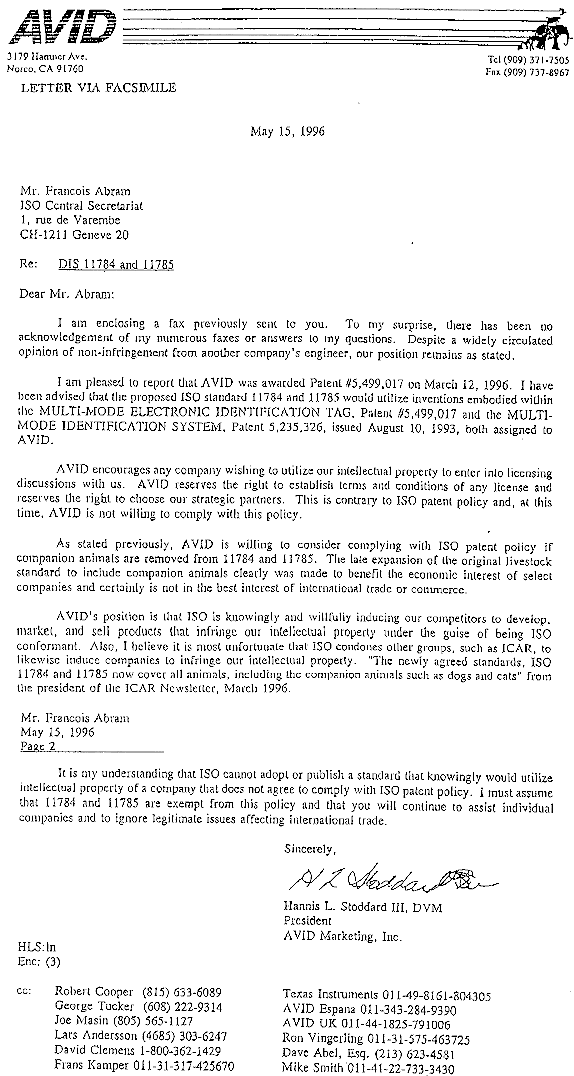
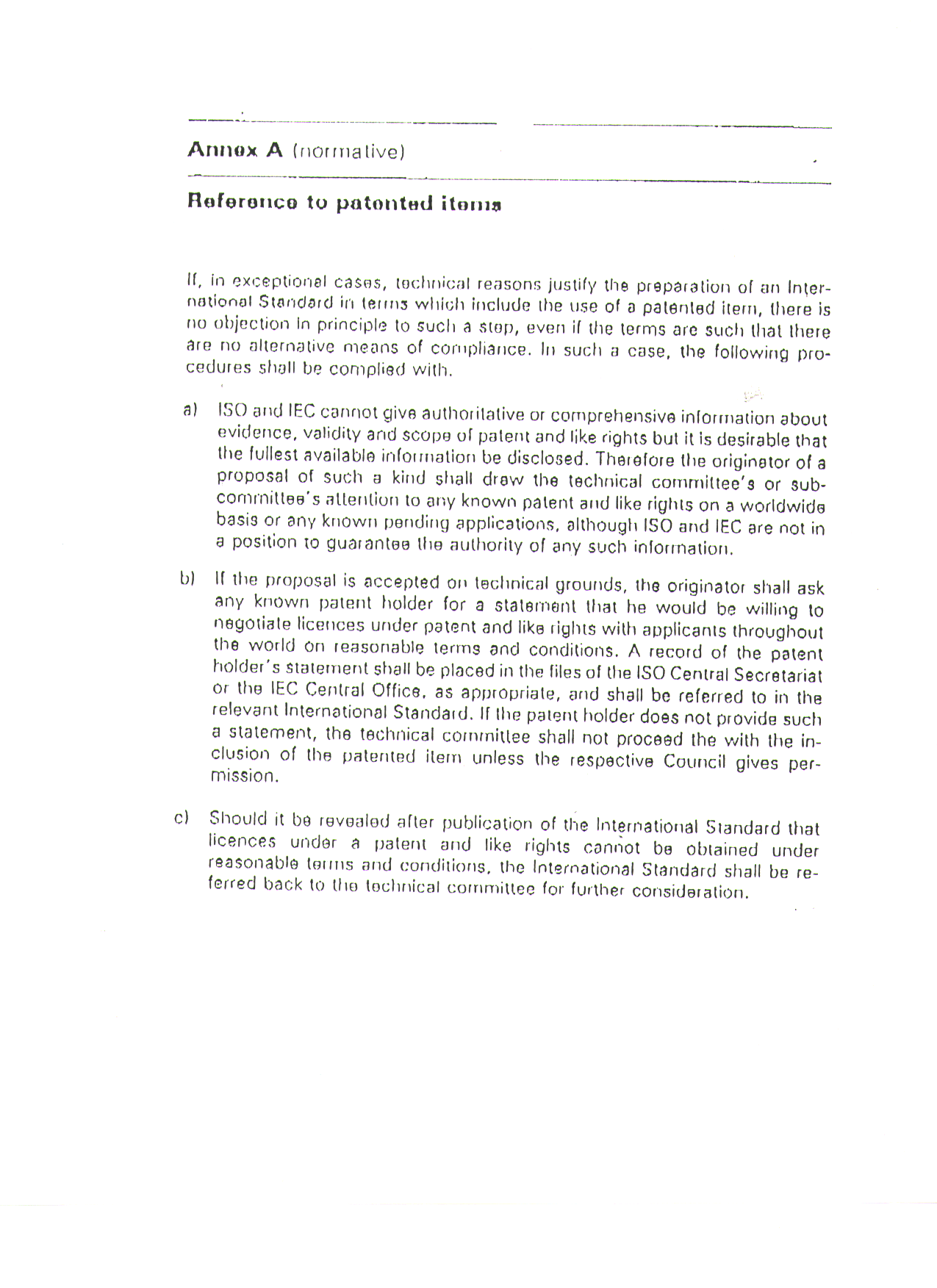
At least one manufacturer alleges that it has patents impacting ISO 11784/85. For
instance, AVID has clearly stated that it does not intend to comply with the ISO Patent Policy as stated in "Patents, N15".
The problems with the standard have become apparent over time. Many of the issues that concern user groups today were initially not recognised because no user input was formally solicited in the early stages of the process. The patent conflicts likewise arose at a fairly late date. A user requirements study, along the lines of what was done by AIM USA preliminary to beginning work on the U.S. companion animal identification standard, has never been conducted by WG3. Such a user requirements study would definitely show the need for a divided standard, guaranteed unique ID codes, for affordable readers and transponders that perform well enough that they can actually be read in their desired applications. It is incumbent upon us all, as responsible manufacturers, to address these issues before users discard the standard as being useless, thereby discrediting the industry that helped create the standard.
For information and questions please contact: Info@EIDLtd.com