ISO 11784/85 Update - SC19 meeting
in Berlin
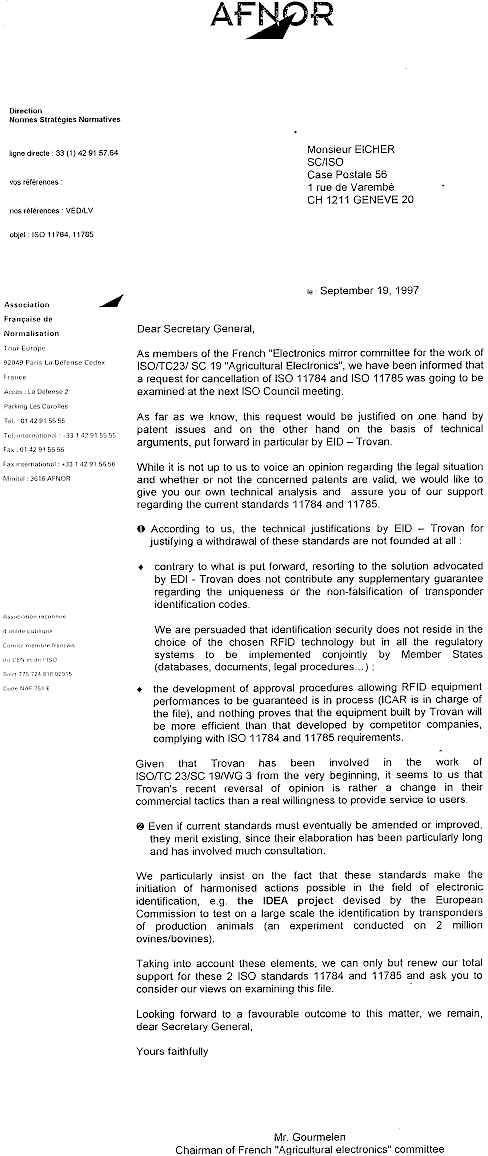
The SC19 meeting in Berlin, which took place on March 12, 1998, dealt with a number of issues, including ISO 11784 and ISO 11785. Item no. 6 on the agenda was a report by the Chairman of WG3, Mr. Wim Wismans, on the current status of the standard. Mr. Wismans was also reporting on the next generation of the animal ID standard, giving a short overview of the recent work of WG3 and of future projects.Several documents submitted by WG3 participants to SC19 were made available to attendees of the SC19 meeting. They included letters by AFNOR, Standard Australia, Standards New Zealand and Gosstandart of Russia, as well as ISO document N125 concerning the request for suspension of ISO 11784 and 11785. After Mr. Wismans finished his report, the Chairman of SC19 stated that Standards New Zealand and Standards Australia had not submitted the previously announced request for suspension of the standards and return of the same to WG3 for review, for which reason no action was required for the time being. At this point, the representative from Gosstandart of Russia requested permission to address the meeting. The Gosstandart representative stated that, although New Zealand had not yet submitted its formal request, Russia had, and that Russia's request should be reviewed by SC19 at this time. Then the representative from Standards New Zealand stated that Standards New Zealand and Standards Australia had created a joint working group (IT28) to address the concerns previously announced by these two organisations to SC19 and the ISO. He stated that the topics were still under discussion and that, because of the short time between the WG3 meeting in Stockholm and the SC19 meeting in Berlin, the document could not be prepared for submission to SC19. He stated that nevertheless, the issues are still being formulated by IT28 and definitely will be provided to SC19 and the ISO. At this point, Dr. Josef
Schuermann of Texas Instruments intervened to question the credentials
of the official representative of Standards New Zealand, and to
question whether the latter was entitled to make any representations
on behalf of Standards New Zealand and Standards Australia. The documents made available to members of SC19 were discussed at this point. Among these was
The Chairman of SC19 stated
that the "Joint Statement" letter was submitted out of
context. Nevertheless, he has allowed Dr. Schuermann to read aloud
the document, in which the signing manufacturers (some of whom are
currently selling ISO 11784/85 compliant transponders, and some
of whom, while not yet doing so, are on record as intending to do
so in the future) are announcing that they are not willing to work
on improvement of the standard, as demanded by some national standard
setting organisations and major user groups. The representative of Polish Standards stated that his organisation's perception was that there were serious difficulties with the standard. He pointed out that major objections were the complexity of the standard (inclusion of both HDX and FDX in the standard); the uniqueness of code; the standard does not allow for backward compatibility with transponders presently being used in Poland in the target applications. Thereafter, the representative of Swedish Standards has suggested that it may be appropriate to return the standard to WG3 for review, which idea was declined by the Chairman of SC19. The reason stated was that an official requirement to do so had not been submitted by Standards Australia or Standards New Zealand. The representative for Standards New Zealand announced that it was his understanding that the official request was to be submitted upon conclusion of deliberations by IT28, in which Standards Australia and Standards New Zealand are participating, and that, however, an official request had in fact been submitted by Gosstandart of Russia. He stated that IT28's meeting was scheduled for mid April. The response to this was that the request has not been presented on the special ISO form for such requests and that the process for such submissions is known to the national standards organisations. At this point, after a spirited debate, the group could not determine if such a form could be made available during the meeting. The form was in fact produced later in the meeting. After the ensuing break, the representatives of Standards New Zealand and Gosstandart each announced that they had made inquiries as to whether the form could be completed and submitted for a vote during the present SC19 meeting in Berlin. Mr. FranÁois Abram, Technical Programme Manager, Standards Department, ISO, apparently did not make a binding statement concerning the applicable voting procedure - whether only SC19 member nations would participate in the vote or whether all ISO member nations would be voting. However, it was determined that ISO, upon receipt of the request for the suspension of the standards on the correct form, will circulate a request for vote on the subject among its (members).
For information and questions please contact: Info@EIDLtd.com
|